
Category: AI Coding Tools
-

Replit AI Review: Is It Worth It in 2026?
Replit AI Review 2026: The Browser-Based Coding Powerhouse Replit AI Review 2026: The Browser-Based Coding Powerhouse Gets Smarter Rating: 4.3/5 Category: AI Coding Best for: Beginners, rapid prototyping, collaborative projects Introduction In the fast-evolving landscape of software development, speed, accessibility, and collaboration are no longer luxuries – they are necessities. Gone are the days of…
-
Cursor Review: Is It Worth It in 2026?
In the rapidly evolving landscape of software development, AI is no longer just a helpful assistant; it’s becoming a foundational co-pilot. Welcome to 2026, where the lines between human and artificial intelligence in coding continue to blur, making developers more productive and innovative than ever before. Today, we’re diving deep into an AI coding tool…
-

How a US Export Directive Killed Anthropic’s Most Powerful AI Models Overnight
On June 12, 2026, the US government issued an export control directive that forced Anthropic to shut down Fable 5 and Mythos 5 — its most capable frontier models — for all users worldwide, yanking access from hundreds of millions of people within hours. The reason? A narrow, non-universal jailbreak that other publicly available models…
-
How Claude Finds Zero-Days Apple’s Fuzzers Miss
Claude found a macOS bug Apple missed entirely. In September 2024, Apple unveiled Memory Integrity Enforcement (MIE) for macOS Sequoia, calling it “the culmination of an unprecedented design and engineering effort, spanning half a decade.” Five months later, an AI model named Claude 3.5 Sonnet tore through that half-decade of work in just five days…
-
How OpenAI Codex Sandboxes AI Code Execution
Why Sandboxing AI Code Matters Codex executes your code in 5 milliseconds. That’s faster than the blink of a human eye, but what happens during those milliseconds—and the seconds that follow—is an intricate choreography of isolation, restriction, and destruction that keeps your machine safe from AI-generated code gone wrong. When OpenAI launched Codex in May…
-

How Claude’s 200K Context Window Actually Works
How Claude’s 200K Context Window Actually Works Claude forgets 80% before you finish typing. Anthropic’s flagship model boasts a 200,000-token context window — enough to ingest 300 pages of a novel in a single prompt — yet research reveals it reliably retrieves information from only the first 40,000 and last 20,000 tokens. The middle? Effectively…
-

How RAG Beats Fine-Tuning at 1/583rd the Cost
Fine-tuning costs 583x more than RAG per query. That number isn’t a typo. When enterprises evaluate how to make large language models useful for their specific domain, the default instinct is often to fine-tune — retrain model weights on proprietary data until the AI “knows” the business. But the economics and engineering reality tell a…
-

How Docker Isolates AI Workloads Using Linux Namespaces
Docker containers share one kernel for thousands of AI models, yet each one believes it owns the entire machine. That illusion of total ownership is what makes containerized AI workloads possible — and understanding how Docker constructs it reveals the real engineering beneath the hype. Key Facts Most People Don’t Know Docker uses Linux namespaces…
-
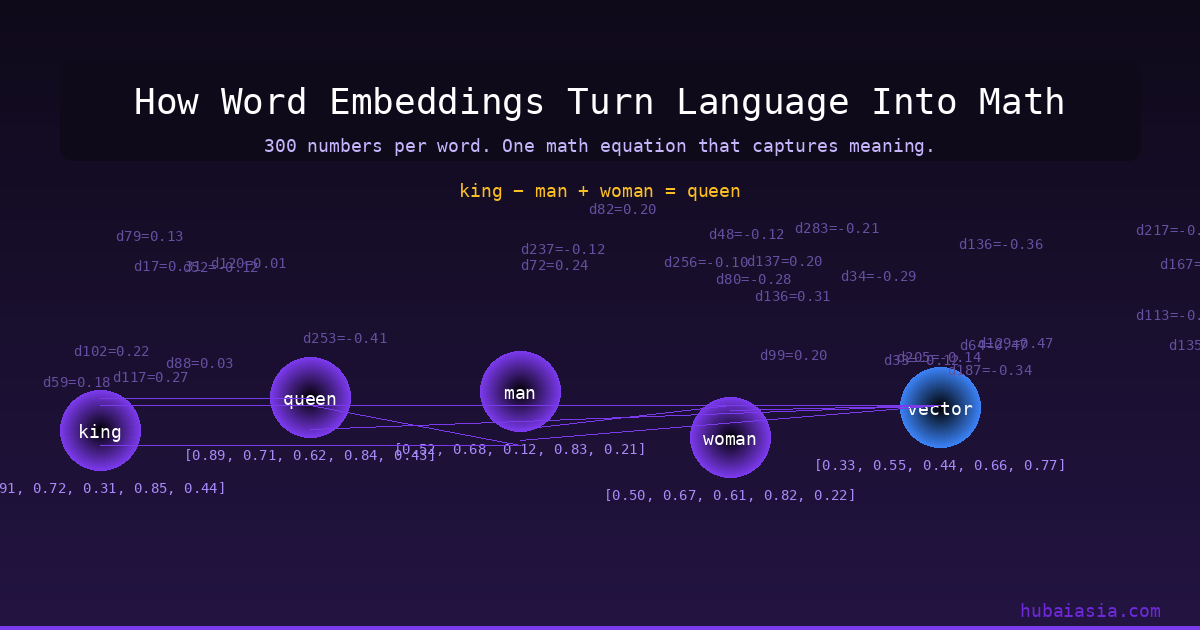
How Word Embeddings Turn Language Into Math
King minus man plus woman actually equals queen. That equation isn’t a metaphor or a clever trick—it’s the literal arithmetic of word embeddings, the numerical representations that power every modern AI system from ChatGPT to Google Search. When you type a prompt into an LLM, the very first thing that happens is your words get…
-

How Claude Learns to Refuse Without Being Told
Claude refuses requests it was never told to refuse. There is no hardcoded list of banned words, no simple keyword filter running behind the scenes. Instead, Anthropic built a system where the model teaches itself which outputs are harmful — and the process is far stranger than most people assume. Key Facts Most People Don’t…